
Finding Austin Resident Records
An Austin residents directory search works best when the question stays narrow. For an address, begin with the county property record and map. For a marriage, birth, or death event, use the state or county vital-record route. A court question belongs with the state court portal and Mower Court Administration. A dated household question belongs with a directory, newspaper, or archive. These sources overlap, but they do not create one master list of Austin residents.
Use a result as a lead, not a conclusion. A parcel card can show an assessed owner or mailing field without proving occupancy. A directory supplies a dated listing. A court index describes a case, not a person’s whole history. The most reliable Austin residents directory trail keeps the record type, jurisdiction, and access date together.
- Standardize a street address with the official USPS lookup, then compare it with the Mower County parcel map.
- Use the assessor’s Property Details and Property Card to capture the parcel number and tax-record context.
- Check the Recorder’s index for recorded transfers, legal descriptions, and document dates when ownership history matters.
- For a past household, ask Austin Public Library or Mower County Historical Society for the closest city-directory or newspaper year.
- When an online source ends, send a defined request to the correct custodian under Minnesota’s public-data law.
Note: Austin is also the Mower County seat, but a postal Austin address and an Austin city address are not always the same geography.
Austin Offices Behind Resident Records
Several Austin offices hold distinct pieces of the local record trail. The Recorder keeps recorded land instruments. The Assessor maintains property assessment information. The Auditor-Treasurer handles county election and local vital-record functions. Court Administration is the route for certified local court files. These are separate custodians, so an Austin search is clearer when it asks one office for one kind of record.
Mower County Recorder
201 1st St NE, Suite 11
Austin, MN 55912
507-437-9446
Mower County Assessor
201 1st St NE, Suite 10
Austin, MN 55912
507-437-9440
Mower County Elections
201 1st St NE
Austin, MN 55912
507-437-9535
The full address-by-address sequence belongs on the Austin street directory page. Here, the important point is custody: the office that created a record is the office that can explain its fields, gaps, and copy rules.
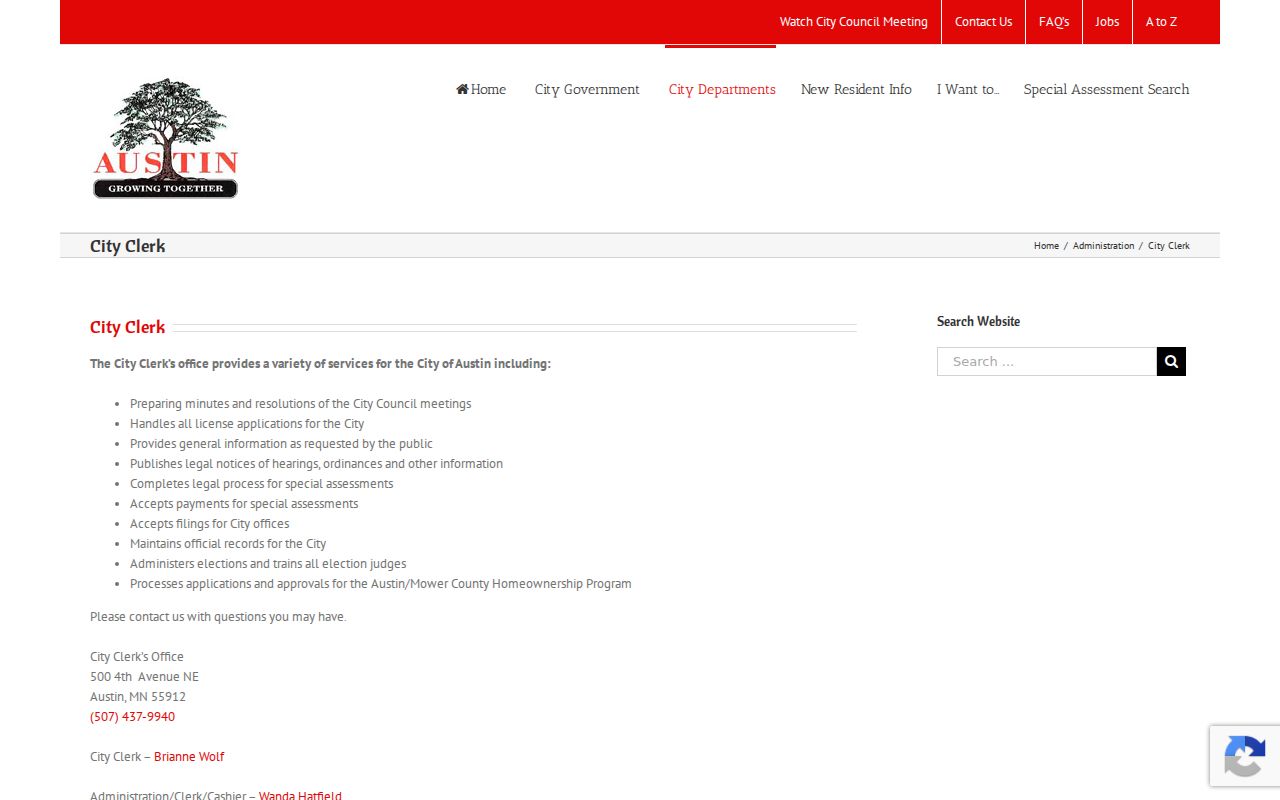
Austin’s City Clerk is another useful fallback when the question concerns city licenses, council filings, legal notices, special assessments, or a defined municipal record. The clerk does not publish a general people-search index. County departments are better for a parcel, deed, voter, or county vital-record question. Keeping the request with the right government unit avoids a misleading negative response.
Austin Parcels Before Names
Mower County’s property instructions direct a researcher to accept the Geospatial Hub disclaimer, search by PIN, name, or address, open Property Details, verify the parcel number, and then choose the Property Card. The card is an assessment document. It may provide a situs address, a displayed owner name, a mailing field, classification, value notices, and property characteristics. It is not a promise that every person at an Austin address appears on the card.
| Property search field | How Mower County describes it |
|---|---|
| PIN / Parcel ID | Text search; county instructions use parcel number, PIN, and Parcel ID. |
| Name | Text owner/name search; exact matching behavior is not stated. |
| Address | Text search; compare the returned parcel number before opening the card. |
| Property Card | Linked after parcel-number verification and described as a two-page PDF summary. |
Austin City Clerk records can be a separate route for a defined city filing, license, resolution, or permit-related request when the county property view cannot answer it.
The City Clerk’s record route is pictured below. It is useful as a reminder that municipal and county files have different custodians.
For Austin residents directory research, name the address, record type, and date range rather than asking for every file connected with a person.
Mower Recorder Coverage Has Two Eras
The Mower County Recorder’s RecordEASE service is a useful Austin residents directory clue for deeds, mortgages, liens, plats, and other recorded instruments. The county page says abstract Grantor/Grantee indexes begin in 1933 and Torrens indexes begin in 1910. The RecordEASE landing notice separately displays images from 1900 and Grantor/Grantee access from 1919. Those notices are not interchangeable. Ask which land system, series, and year apply before treating a missing search result as a real absence.
RecordEASE requires a login and charges for searches and document views. The Recorder also provides a public computer in the office. That counter route matters when a login screen does not reveal the field choices or an older series needs staff guidance. A recorded deed can establish a legal transfer and date, but it does not by itself establish a current resident.
- Parcel
- A county’s numbered unit of land, used to connect a street address with assessment and map records.
- Grantor / grantee
- The party transferring an interest and the party receiving it in a recorded instrument.
- Index
- A finding tool that points to a record; it is not necessarily the record image or a certified copy.
- Criss-cross directory
- A reverse street listing that can connect an address to a dated directory entry.
Note: The Recorder’s public-computer option is the practical fallback when authenticated RecordEASE details cannot be inspected online.
Austin Voter Checks Use Addresses
MNVotes is an address-based registration check, not a public Austin residents directory download. It asks for first and last name, then a ZIP Code or county route, city or township, house number, street, and a unit number when needed. The state says the lookup updates nightly, while local election officials may take up to 14 days to process a change. A match confirms a registration workflow, not a permanent address history.
Minnesota Statutes section 201.091 governs broader voter-list access. The law treats certain registration information as public, but a requester must make the required use affirmation, and a whole-street search is not what the public web lookup provides. Protected participants in the Safe at Home program require different handling.
Minnesota’s registration tool appears below. Entering a full address is part of the official process, which is why a name alone is not enough for this Austin check.
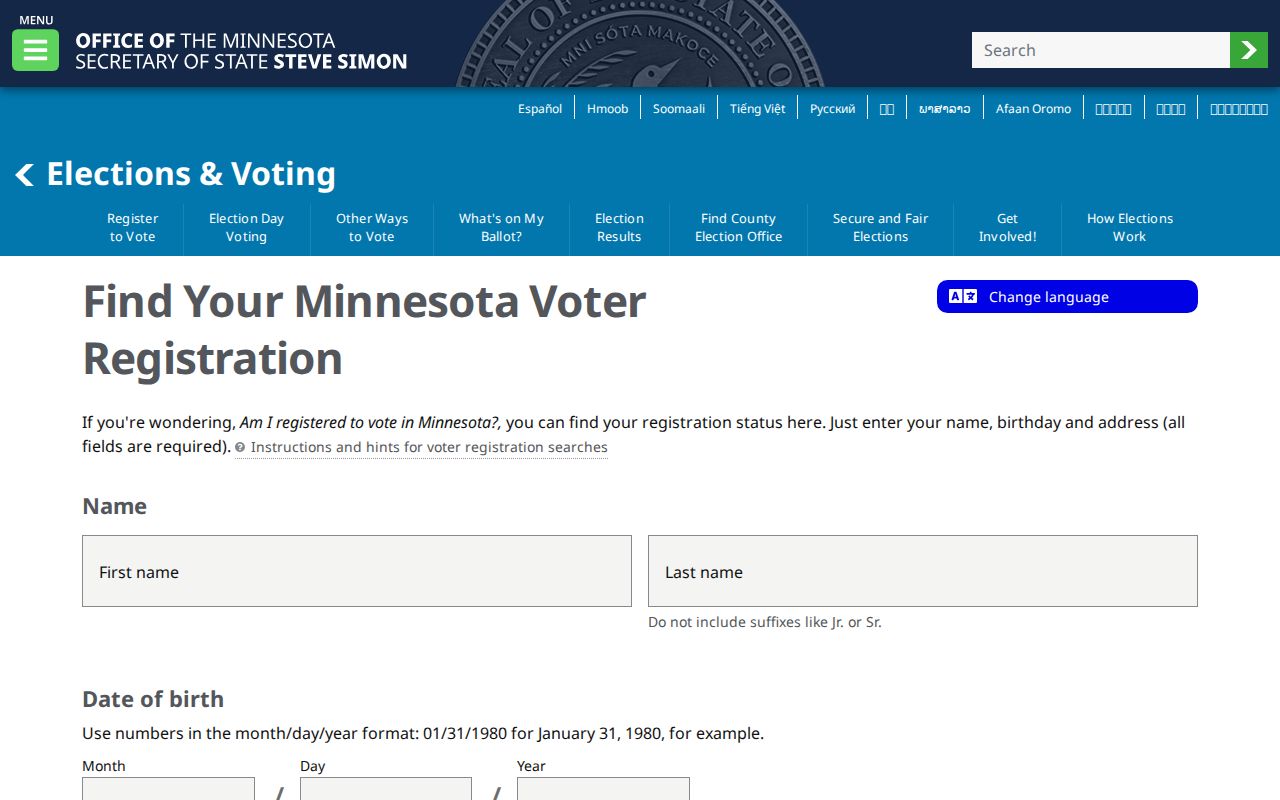
Keep any voter result in the limited context the election office provides. Do not republish voting history or use a public record to expose a protected address.
Austin Vital Paths Confirm Events
Vital records are event records, not an Austin residents directory. Mower County’s local registrar and the Minnesota Department of Health serve different parts of the birth and death process. Mower marriage certificates are found through the county that issued the license, with Mower’s MOMS coverage beginning September 22, 1857. The Minnesota Historical Society People Records Search offers historic birth and death index ranges, while a certificate follows its own eligibility rules.
For a Mower marriage request, confirm that the result’s county is Mower before using the copy route. For birth records, Minnesota Statutes section 144.225 and the Department of Health’s tangible-interest rules determine whether a certified copy may be issued. Death noncertified records are broadly available, but that does not erase the need to check the custodian’s current form and payment instructions.
Minnesota’s Office of Vital Records supplies the statewide explanation of birth and death access.
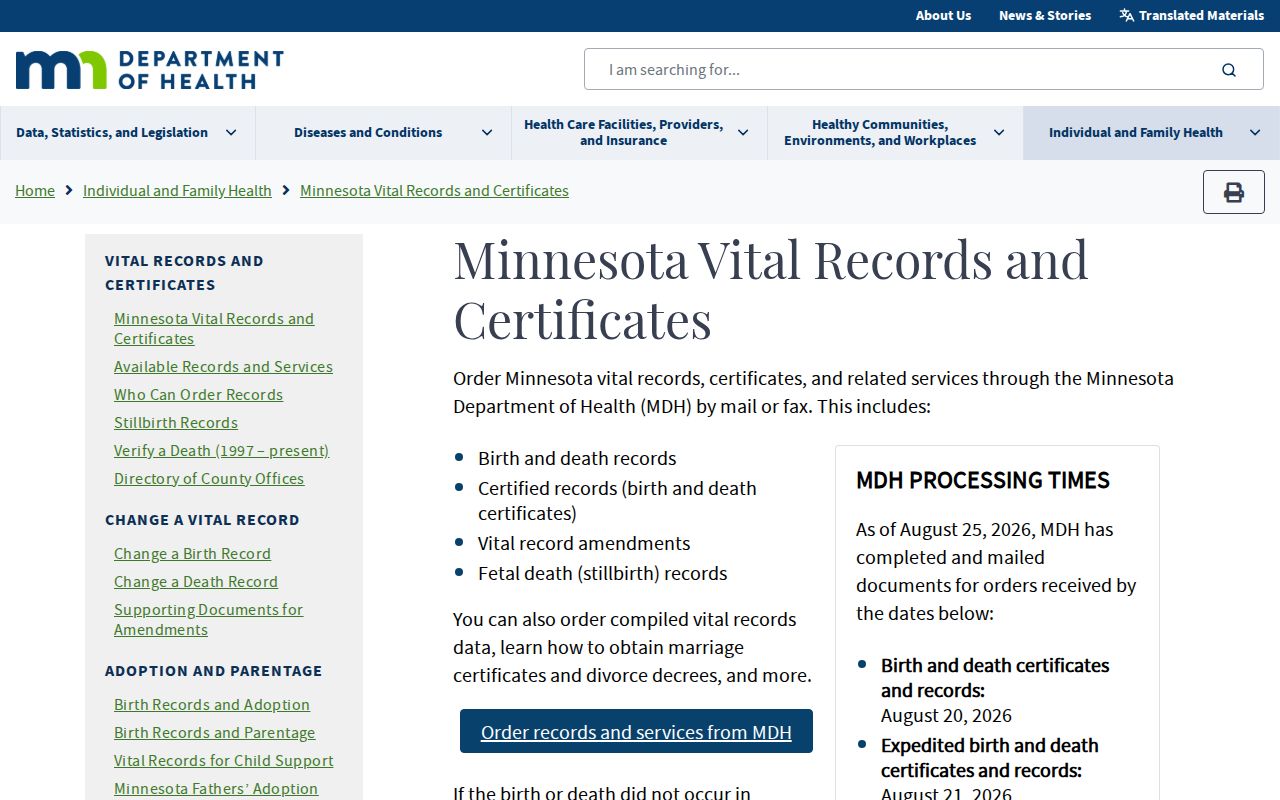
Use the date, county, and event type from a vital source to verify a historical trail. Do not turn an index hit into a current-location claim.
Austin Court Results Need Context
Minnesota Court Records Online, or MCRO, is the state district-court discovery portal for Mower County. It supports Name, Case Number, Citation Number, and Attorney searches. A name search can be narrowed by party type, sounds-like option, date of birth range, filing-date range, case category, status, and court location. Same names remain a problem, so a case number, county, party role, and filing date should travel with every result.
MCRO does not show all material. Protected domestic-abuse and certain child-protection matters, party street addresses, comments, and some pending criminal or traffic matters have limits. It does not issue certified copies. Mower Court Administration is the local path for certified files, paper records, and documents outside web access. Federal court matters belong to a separate federal system.
A careful court verification uses at least two facts. Compare the county, case category, party role, filing date, and case number before connecting a result to an Austin person. The public portal can narrow to Mower, but an index hit is not a certified document and an omitted name search does not prove no case exists. Ask Court Administration about a defined file, fee, or access rule rather than trying to infer a protected record from a missing result.
Current Austin Resident Sources
Current sources in an Austin residents directory answer different questions. The property view is parcel based. The election lookup begins with an address. The Recorder’s index identifies parties to instruments. A jail roster is a current custody report, while the Department of Corrections locator covers a different jurisdiction. Each source needs its own date and boundary.
| Austin source | What it can confirm | Custodian | Access boundary |
|---|---|---|---|
| Property Card | Parcel, assessment, and displayed owner or address fields | Mower County Assessor | Public viewer; not an occupancy guarantee. |
| MNVotes | Address-based registration status and districts | Minnesota Secretary of State | Not a whole-street public download. |
| RecordEASE | Recorded transfers, parties, and legal descriptions | Mower County Recorder | Fee/login route or office computer; series differs. |
| MCRO | State district-court case fields where returned | Minnesota courts | Protected material and certification limits apply. |
| MCHS and APL | Dated directory, yearbook, newspaper, and archive clues | Local library and archive | Historical snapshots; item access varies. |
When the goal is one person rather than a record category, the Austin resident lookup route uses two independent details to avoid a same-name mistake.
Austin Custody Sources Have Borders
The Mower County Jail publishes a generated roster report for current local custody. It is not a historic database or a general list of Austin residents. Minnesota DOC’s locator covers people under state correctional jurisdiction, and federal custody is a different system again. The court docket can help identify an underlying state case, but it does not replace custody confirmation from the proper office.
Mower County’s jail information page is shown below. The roster should be treated as a time-sensitive report, then verified with the jail before relying on it.
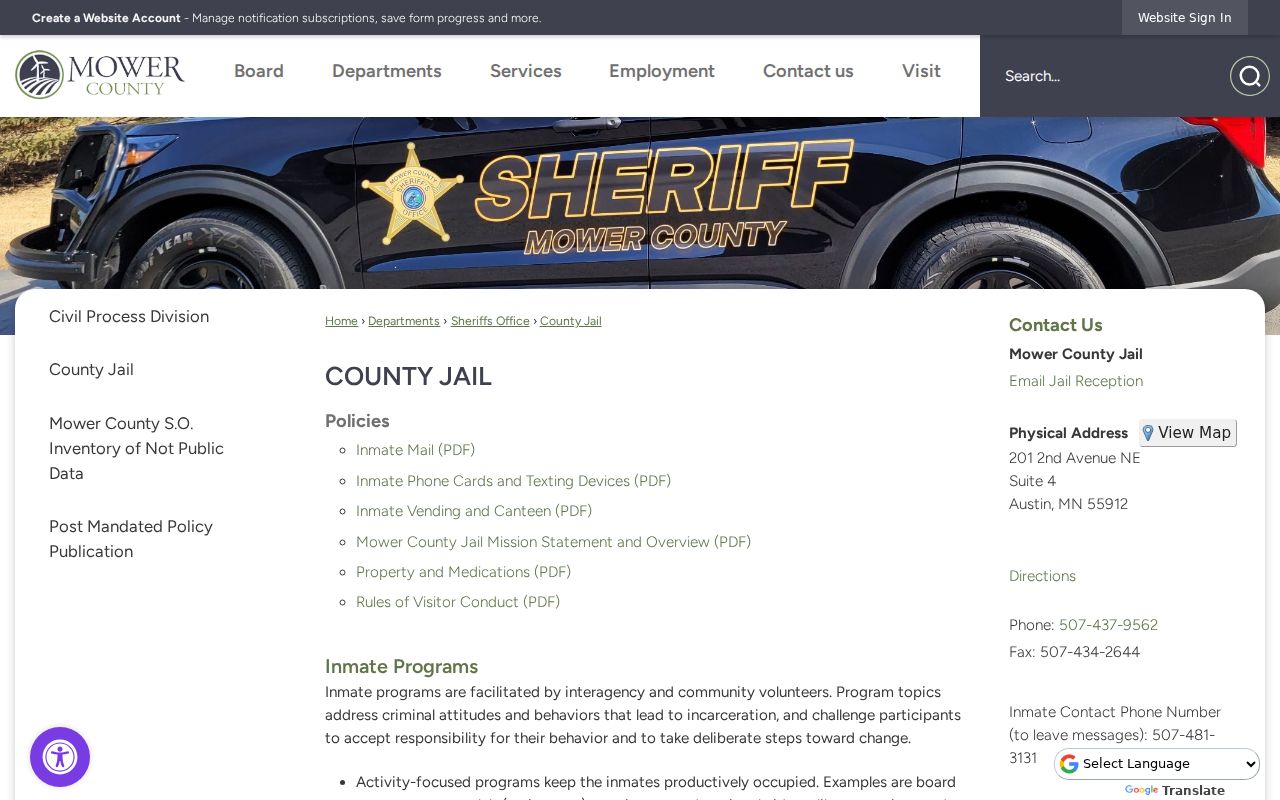
A blank result from one custody source does not settle another jurisdiction. Use the local jail, state locator, federal locator, and court record only for the separate question each one answers.
Austin Requests Under MGDPA
The Minnesota Government Data Practices Act, especially Minnesota Statutes section 13.03, presumes government data are public unless another law classifies them differently. A sound Austin request identifies the government entity, precise record type, name, address or parcel number, date range, preferred format, and whether inspection or copies are wanted. The custodian may provide the data, request clarification, explain that no data exist, or cite a lawful restriction.
Start with the record holder: City Clerk for city records, Assessor or Recorder for county property records, Court Administration for court files, and the Auditor-Treasurer for local election or marriage functions. Mower County’s Services page links the NextRequest route. Inspection has no charge under the statute’s general rule, while copying and retrieval can have lawful costs. A request does not override Safe at Home, protected court files, vital-record eligibility, or voter-list conditions.
Austin Privacy Is a Record Limit
A public index is not permission to assemble a dossier. Minnesota Safe at Home uses a substitute address for qualifying people facing safety risks, and their real address is not sent to the local elections office. Court and vital systems also keep some records or fields out of public web results. The strongest Austin residents directory practice is to publish or share only the record type, date, jurisdiction, source, and access limit needed for a lawful question.
Commercial people-finder services combine data from different dates and sources. Their category is not a substitute for the original Austin or Minnesota custodian, especially where an address, event date, or identity needs verification.
Austin Directory and Newspaper Shelf
Historical Austin residents directory research has a strong local shelf. FamilySearch catalog metadata identifies Austin and Mower volumes from 1905 through 1959 with gaps, plus Keiter Directory Company editions for 1993 and 1997. The catalog describes alphabetical private-citizen and business lists, a householders street guide, classified listings, community institutions, and numerical telephone material. Verify the individual volume and publisher before treating the listed years as a continuous run.
Mower County Historical Society holds city directories, plat maps, yearbooks, Tombstone Trails listings, vertical files, township microfilm, and bound or microfilm newspapers. Austin Public Library links genealogy and Austin Daily Herald resources. The Mower County Mirror began in 1858, and several local newspaper titles overlap, which matters when a notice is missing from one paper. The fuller collection and entry-reading method is on the Austin city directory page.
The historical setting helps select an archive search term. Austin’s official history identifies the Headquarters Building, Oakwood Cemetery, the Floral Club library origin, and the early Mower County Mirror. These are useful words for a Mower County Historical Society vertical-file or newspaper query, but they are not substitutes for a dated directory entry or official record. For each Austin household trail, retain the volume year, page or image reference, and the way the source described the person.
Note: A directory entry is a dated clue about the person, address, or role that volume chose to print, not proof of continuous residence.