
Austin Resident Lookup Record Paths
One name can point to several different record systems in Austin and Mower County. The useful question is not whether a master resident list exists, because it does not. Instead, choose the record that matches the fact at issue, such as a parcel ownership link, a court case, an event date, or a registration status. Each result has a different access rule and a different limit.
| Record | What It Confirms | Where | Access |
|---|---|---|---|
| Mower property record | Parcel, displayed owner, mailing address, legal and assessment details | Mower County GIS | Public map and Property Card workflow |
| Voter registration | Registration lookup or district workflow at a supplied address | MNVotes | Address lookup; broader list has statutory rules |
| Court index | Case number, party role, category, filing date, location and returned status | MCRO | Free discovery; clerk handles files and certified copies |
| Vital indexes | Marriage, birth or death event clues | MOMS and MDH/MNHS routes | Index and copy eligibility differ |
| Historical sources | Dated school, directory, obituary or newspaper clue | Austin Public Library and Mower County Historical Society | Library, archive, or assisted research |
Start with a parcel or an address only when it is already known. Use a name search to discover candidates, not to decide identity. A court result, voter result, directory entry, and certificate are not interchangeable. Record the source, the date seen, the county, and the fields returned before moving to the next source.
Note: A name-only match remains a candidate until two independent facts agree.
Austin MCRO Name Searches
Minnesota Court Records Online, known as MCRO, is the state district-court discovery portal for Mower County. It offers Name, Case Number, Citation Number, and Attorney searches. In Name mode, the person or business choice, last, first, and middle fields can be combined with an optional Sounds Like setting, date-of-birth or filing-date ranges, case categories, status, and a Mower location filter. Use the portal’s own navigation controls instead of a browser Back button.
| MCRO field or control | Use in a Mower search |
|---|---|
| Name type and name fields | Choose Person or Business, then enter last, first, and middle name where known. |
| Sounds Like | Discovery aid for variant spellings, not identity proof. |
| Date filters | Use an exact date or From/To range for date of birth or filing date. |
| Category and status | Narrow Civil, Criminal, Family, Probate, or Mental Health results and the available status selector. |
| Court location | Select Mower to focus the Austin-area result set. |
MCRO does not return every court record. Defendant-name searches exclude pending criminal, traffic, and petty-misdemeanor cases with no conviction. Protected domestic-abuse and HRO material, CHIPS and D16 matters, certain civil-commitment records, party street addresses, comment fields, and other nonpublic material have limits. Public courthouse terminals and local files may provide a different permitted view.
See the MCRO case-search interface before entering a narrow name-and-county query.
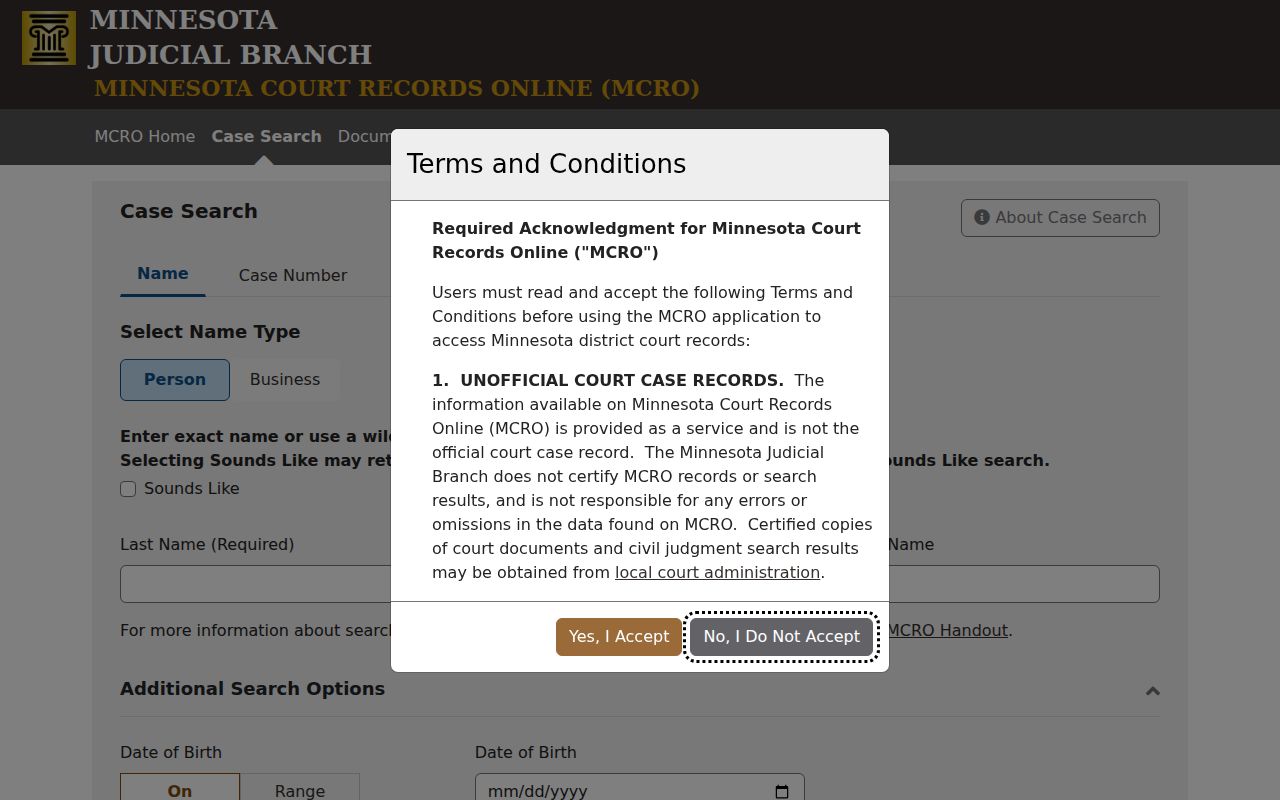
The Austin resident lookup image reflects the official court discovery route, where a returned case still needs independent identity checks and any certified copy comes from Court Administration.
Austin Resident Lookup Name Checks
Common names create the largest error risk. Search the exact legal name first, then try a middle initial, married or former name, and permitted spelling variants. MCRO’s Sounds Like feature can surface a lead, but the court itself warns that people with the same name may not be the same person. Compare a party role, filing date, county, age or date range, address clue, and case context before treating a result as belonging to the person sought.
For a local address question, the documented Mower property workflow accepts PIN or Parcel ID, Name, and Address searches after the map disclaimer is accepted. Open Property Details, verify the parcel number, and use the Property Card as a parcel-level record. A displayed owner or mailing address is a property clue, not proof that every household member lives there or that occupancy has continued without change.
Separate record dates as well. A recording date, assessment date, filing date, event date, publication date, and portal access date describe different things. That simple habit makes a later correction much easier.
Austin Vital Record Routes
Vital records can verify an event or a relationship, not a current address. Mower County’s local registrar is the Auditor-Treasurer at 201 1st St NE, Suite 7, Austin, 507-437-9535. The county reports local birth and death records beginning in 1870, while the statewide MDH systems begin with births in 1900 and deaths in 1908. The Minnesota Historical Society People Records Search covers births from 1900 through 1934 and deaths from 1904 through 2001.
For marriages, MOMS covers Mower County from September 22, 1857 to the present. Before 2013, begin with male-party information; from 2013 forward, either party can be used. Set a matching From/To date for a common name, confirm that the county returned is Mower, then choose Request a Copy. The researched certified-copy price is $9, subject to the current form and county process.
MDH is the state route for birth and death copies. A birth application may be mailed or faxed for card payment, but MDH does not accept it by email and has no St. Paul counter service. Mower’s registrar is the practical local walk-in route. Certified access depends on the relationship, authority, record status, identification, and, where required, a notarized application. Noncertified death information is broadly available, but a certificate still has rules.
Review MDH tangible-interest guidance before requesting a certificate.
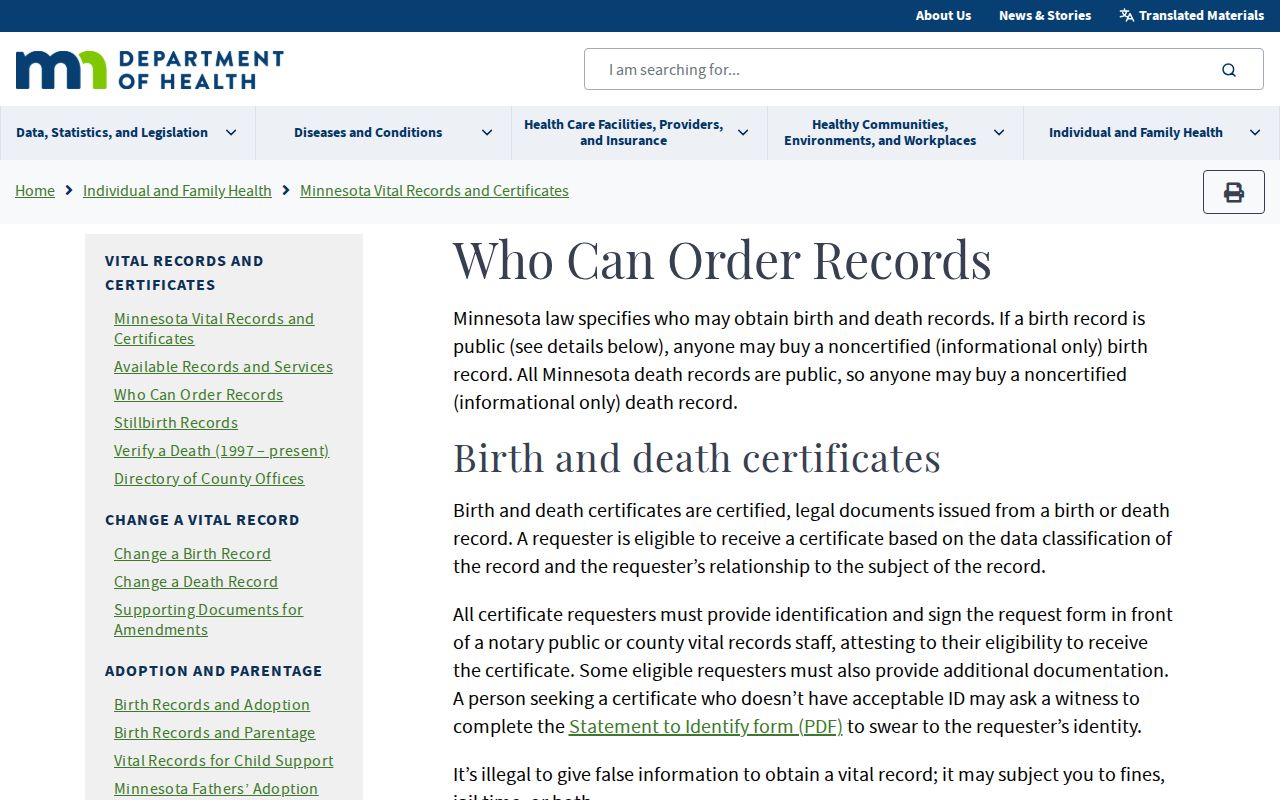
The official vital-record guidance shows why an index hit, an event record, and an eligible certified copy have separate access boundaries.
Austin Resident Lookup Result Fields
A responsible note captures what the result actually displayed. The research inspection did not retain a named Austin person’s case, so the following is an inventory of documented MCRO result fields rather than a person-level example. It is useful for deciding whether a result can support the next verification step.
| MCRO result field | What to record |
|---|---|
| Case and party details | Case number, party name, party role, court location, and Mower County filter used. |
| Case context | Category, filing date, status or disposition when returned, citation or attorney mode where relevant. |
| Docket access | Docket or document link only where the portal makes it available; note redactions or excluded fields. |
| Certification path | MCRO does not issue certified copies. Ask Mower County Court Administration for files or certificates. |
Mower County Court Administration lists mowercourts@courts.state.mn.us and 507-509-7013. State fee guidance lists $14 for a certified copy, certified printout, certified scan of a dismantled file, or certified screen print. That fee is not a promise that a particular file is public or available.
Note: Preserve the exact portal URL and access date with every court search note.
Confirming an Austin Resident
A verification chain works best when it starts with a fact that is already known and ends with the custodian that can lawfully supply the record. For a person connected to a local parcel, use the property result as a starting point, then test the name in the court and event indexes. Do not fill gaps with a guess. A voter search is especially limited because an address-based match is a registration result, not a whole-person profile.
- Locate the known Austin address or name in the Mower property workflow. Save the parcel number, legal description, assessment date, and the displayed owner or mailing field.
- Run MCRO with the name and Mower location. Compare party role, case category, filing date, and any returned status with the property or other independent facts.
- Use MOMS, the MNHS indexes, or an MDH route only for an event question that fits the record. Record the date, county, and access class separately.
- Request a permitted certified copy or local file from the proper custodian only after the match is supported. Keep the index result and certified record distinct.
- Docket
- A court’s running case record, which can show filings or events where public access permits.
- Index versus image
- An index points to a record and may show limited fields; an image is the underlying scanned document and can have a fee or access limit.
- Certified copy
- A copy authenticated by the custodian for the record type; MCRO discovery results are not certified copies.
Austin Record Request Options
Minnesota Government Data Practices Act, Minn. Stat. ch. 13, presumes government data are public unless another law classifies them differently. Minn. Stat. §13.03 allows inspection at reasonable times and copies subject to lawful costs. Inspection itself has no fee. A narrow written request should name the government entity, record type, date range, person, address, or parcel identifier, and whether inspection or electronic copies are preferred.
For Austin city material, start with the City Clerk. For county material, send the request to the responsible Mower department or use the county Services page and its NextRequest route. A custodian may provide access, ask for clarification, say no responsive data exists, cite a classification, or issue a lawful denial. A request does not override court protection, vital-record eligibility, voter-list limits, or a confidential address.
If a classmate or family-history question needs an older source, Austin Public Library and the Mower County Historical Society offer a safer route through yearbooks, directories, newspapers, cemetery listings, township records, and assisted research. Those are dated historical clues, not current contact records.
Austin Resident Lookup Numbers
Mower County reports roughly 21,300 parcels assessed each year, while the county elections page provides about 22,000 registered voters as a dated scale clue. Those figures describe separate systems. A parcel count measures assessed properties, and the elections figure describes registered voters at a point in time. Neither number is a count of current Austin residents, a list of households, or a way to identify one person.
The scale explains why an Austin resident lookup needs a narrow starting point and two-source confirmation. A full name plus a date, known address, parcel number, event, or county can reduce the same-name problem. When the record system has no direct match, write the source and search scope rather than concluding that a person has no record.
Austin Resident Lookup Privacy Limits
Minnesota’s public-data rules do not make every personal detail available. Under Minn. Stat. §201.091, a voter-list request has an eligibility and permitted-use affirmation, while the full date of birth in the master list is restricted. Minn. Stat. §144.225 and MDH tangible-interest rules limit birth and certified vital access. MCRO withholds or limits protected court material. A record that is absent from a public search may be protected, outside the source’s coverage, or held by another custodian.
Safe at Home, Minnesota Ch. 5B, provides qualifying participants with a substitute address and mail-forwarding system. A public request is not a route to a participant’s real address. When a field looks wrong, retain the source, identify the exact field, contact the office that created the data, and ask for the formal correction or appeal process rather than copying the error forward.
Lawful use. An Austin resident lookup is for personal, lawful research, such as family history, an estate question, or confirming a record. Minnesota’s anti-stalking law, Minn. Stat. §609.749, bars conduct used to harass, monitor, or intimidate another person.